Scroll, Compare, Spiral: What Endless Dance Content Is Doing to the Way You See Yourself
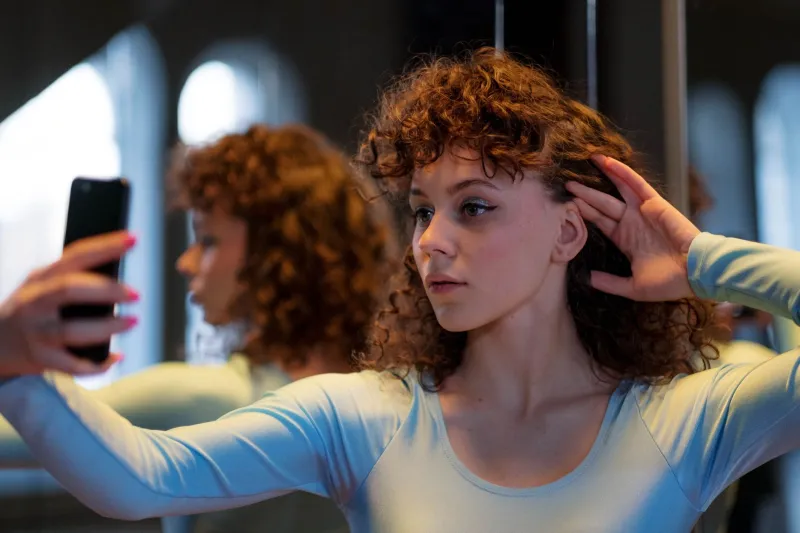
You didn't mean to spend forty minutes watching other dancers. You opened the app to check one notification, and then somehow it was midnight, your tea was cold, and you were lying in bed feeling vaguely terrible about your extensions, your turnout, your entire relationship with your own body. Sound familiar?
You're not alone — and you're not weak for falling into it. What's happening to dancers on social media right now is something therapists, coaches, and performers across the country are starting to talk about more openly. The comparison trap isn't new, but the internet has given it a megaphone, a highlight reel, and an algorithm that knows exactly how to keep you watching.
The Feed Was Never Neutral
Here's the thing nobody tells you when you first download TikTok or Instagram: the content you're seeing isn't representative. It's curated, filtered, lit carefully, and often the result of fifty takes. The dancer who appears to effortlessly nail a triple turn in six seconds might have spent three hours getting that clip. You're not watching dance — you're watching the best possible version of one moment, stripped of all context.
Dr. Renata Solis, a licensed psychologist based in Chicago who works extensively with performing artists, puts it plainly. "The brain doesn't automatically register that what it's seeing is a constructed image," she says. "We evolved to compare ourselves to people in our immediate environment. Social media throws your brain into a comparison loop it was never designed to handle — hundreds of bodies, hundreds of skill levels, all appearing to be better than you, all at once."
That loop has a name in psychology: social comparison theory. First articulated by Leon Festinger back in the 1950s, the idea is that humans naturally evaluate their own abilities and worth by measuring against others. In a dance studio, that comparison is bounded — you're looking at maybe fifteen people who share your training context. Online, the comparison pool becomes infinite. And infinite comparison almost always trends toward feeling worse about yourself.
What Dancers Are Actually Experiencing
Tamika Reeves, a contemporary dancer based in Atlanta who has been training for twelve years, describes the shift in her mental state over the past few years as gradual and disorienting. "I used to feel proud of my progress," she says. "I had a strong arabesque. My teachers told me so. Then I started spending more time on Instagram, and suddenly my arabesque felt like nothing. Like it wasn't even worth mentioning."
Tamika's experience isn't unusual. Across dance communities — from competitive studios in the Midwest to pre-professional ballet programs on the coasts — teachers and mental health professionals are noticing similar patterns. Students are arriving to class demoralized not by something that happened in the studio, but by something they watched on their phones the night before.
Jordan Fitch, a dance educator who runs a contemporary program in Portland, Oregon, started asking students to journal about their social media habits after noticing a troubling trend. "I'd have kids come in and immediately start apologizing for their bodies before class even began," Jordan says. "They'd seen someone online and decided they were already behind. It was affecting how willing they were to take risks in class."
The body image dimension is especially sharp. Dance has always had a complicated relationship with how bodies look versus what bodies can do — that tension predates social media by decades. But platforms like Instagram have introduced a new layer of visual pressure that's harder to escape because it follows you home, into your bedroom, into your quietest moments.
The Algorithm Is Not Your Friend
It's worth being direct about how these platforms work, because understanding the machinery helps. TikTok and Instagram are not designed to make you feel good. They're designed to maximize engagement, which often means serving you content that provokes a strong reaction — including envy, inadequacy, and the compulsive need to keep watching to find something that makes you feel better (which rarely comes).
The more you engage with dance content — even just by watching — the more the algorithm reads that as interest and serves you more. Which means that the dancer who's already feeling bad about their flexibility is going to get served more flexibility content, not less. It's a loop that tightens around you gradually enough that most people don't notice it happening.
Dr. Solis calls this "aspirational doom-scrolling" — the experience of consuming content that you think is motivating you but is actually eroding your baseline sense of satisfaction with your own practice. "There's a difference between inspiration and comparison," she says. "Inspiration leaves you energized. Comparison leaves you depleted. And a lot of what passes for inspiration in dance spaces online is actually just comparison wearing a motivational caption."
Finding Your Way Back to Your Own Body
None of this means you have to delete every app and live off the grid. Social media has genuinely opened up dance culture in beautiful ways — connecting artists across geography, amplifying underrepresented styles, and giving independent choreographers a stage they never had before. The goal isn't avoidance. It's awareness, and then intention.
A few things that dancers and therapists consistently recommend:
Audit your feed ruthlessly. If an account consistently makes you feel worse about yourself, unfollow it. Not because the dancer is bad or the content is harmful in some absolute sense, but because your nervous system doesn't need that input right now. You can always come back later.
Set a context rule for yourself. Don't scroll dance content right before or after class. Give yourself a buffer where your relationship with your body is about sensation and movement, not visual comparison. Tamika started putting her phone in her car during studio hours and describes it as "genuinely life-changing."
Distinguish between consuming and learning. Watching a tutorial on technique with the goal of understanding something specific is different from passively scrolling and absorbing whatever the algorithm decides you should see. One is intentional. The other is where the spiral starts.
Talk about it out loud. The comparison trap thrives on silence. When dancers start naming what they're feeling — in class, in conversation, in community — it loses some of its grip. Jordan now opens every semester with a conversation about social media and self-image. "It changes the whole culture of the room," they say.
The Body You Have Is the Body You're Dancing In
Here's the thing about your arabesque, your turnout, your extensions, the shape of your body in motion: none of it looks the way it looks on someone else's feed. It looks like yours. And your practice, your growth, your relationship with movement — that's happening in real time, in a real body, in a real room. The algorithm can't measure that. It can't even see it.
The dancers who seem to navigate social media with the most grace are the ones who've figured out, usually through some amount of struggle, that their practice doesn't live on their phone. It lives in the studio, in the rehearsal room, in the quiet moments when the music is playing and nobody's filming and you're just moving.
That's where you actually are. That's where you actually get better. And no amount of scrolling is going to touch it.