When Words Aren't Enough: How Dancers Are Using Movement to Move Through Grief
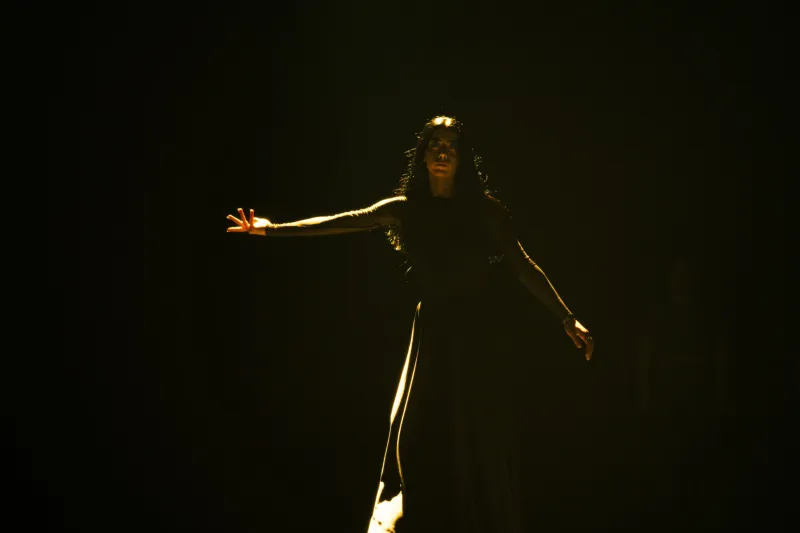
There's a particular kind of silence that follows a loss. Not peaceful quiet — the kind that presses in on you, heavy and airless, the kind that makes words feel embarrassingly small. Dancers know something about that silence. They've spent their whole lives learning to say things the body can hold that the mouth can't.
And lately, more and more of them are turning that instinct toward grief itself.
Across the country, choreographers, somatic practitioners, and everyday movers are creating work — sometimes for stages, sometimes just for themselves — that treats mourning not as something to be talked through, but as something to be moved through. The results are striking, not just artistically, but in terms of what they're doing for the people making the work.
The Body Keeps the Score, and the Studio Keeps the Body
If you've spent any time in wellness circles, you've probably heard the phrase "the body keeps the score" — the idea, popularized by psychiatrist Bessel van der Kolk, that trauma and loss don't just live in the mind. They live in muscle, in breath, in the way we hold our shoulders when we think no one's watching.
Neuroscience is catching up to what dancers have always intuited. Research suggests that movement activates the cerebellum and limbic system simultaneously — areas of the brain associated with both motor control and emotional regulation. Unlike traditional talk therapy, which primarily engages the prefrontal cortex, somatic movement can access emotional memory stored in the body before the thinking brain even gets involved.
In plain terms: sometimes you can move through something you can't yet think through.
Dance therapist and choreographer Renata Solís, based in Chicago, has been building her practice around exactly this idea for over a decade. "Grief has a texture," she says. "It has weight and speed and direction. When I ask someone to show me their grief through movement instead of describing it to me, something completely different comes out. Something more honest, usually."
Solís works with both clinical populations and performing artists, and she draws a clear line between dance therapy and grief-centered choreography — though she says the two are more porous than people assume. "The choreographers making work about loss aren't just making art. They're doing something deeply somatic, whether they call it that or not."
Making the Private Public
For New York-based choreographer Marcus Delray, the decision to make grief-centered work was never really a decision at all. After losing his mother in 2021, he found himself in the studio almost involuntarily, moving in ways that surprised him.
"I wasn't trying to make a piece," he says. "I was just trying to get through the day. But the studio was the only place where I didn't feel like I had to explain myself. The movement just... knew."
What emerged became Forty Days, a 45-minute work that premiered at a Brooklyn performance space last spring. The piece doesn't narrate grief — there's no mime of crying, no literal representation of loss. Instead, it works through repetition, weight-sharing, and the deliberate slowing of time. Audiences reported feeling something shift in their own bodies while watching it.
That's not a coincidence. Mirror neurons — the neural mechanisms that cause us to internally simulate the movements we observe — mean that watching a body in grief can activate something grief-adjacent in a viewer's own nervous system. It's not voyeurism. It's resonance.
"People came up to me afterward crying, but not in a sad way," Delray says. "They said things like, 'I don't know why I'm crying, but I feel lighter.' That's the thing grief-centered dance can do that a grief memoir can't. It bypasses the story and goes straight to the sensation."
Collective Mourning on Stage
Individual loss is one thing. But some choreographers are reaching for something bigger — the kind of collective grief that accumulates from mass tragedy, systemic violence, or the slow erosion of communities.
Los Angeles-based dance collective Tierra Viva premiered Undone, a piece responding to the grief of immigrant families separated at the border, in 2023. The work was developed through community workshops where participants — many of them not professional dancers — contributed movement phrases drawn from their own experiences of loss and longing.
"We weren't trying to speak for anyone," says the collective's co-founder, Yesenia Arroyo. "We were trying to create a container where all of that grief could exist together without being fixed or resolved. Because it isn't fixed. It isn't resolved."
The distinction matters. Grief-centered dance, at its best, doesn't promise catharsis in the theatrical sense — the tidy emotional release that leaves you feeling cleansed. It offers something messier and more honest: acknowledgment. The body witnessed. The loss made visible without being made neat.
What This Means for the Rest of Us
You don't have to be a professional dancer or a grief therapist to access what this work is pointing toward. The principle — that the body is a legitimate site of mourning, not just a vessel carrying a grieving mind — is available to anyone willing to move.
Somatic movement classes focused on grief and loss are growing in popularity across the US, offered through dance studios, hospice programs, and community mental health organizations. Some are structured around specific losses; others are more open-ended, inviting participants to bring whatever the body is currently carrying.
Solís recommends starting simply. "Put on music that feels connected to the person or thing you've lost. Don't try to dance. Just let your body respond. See what wants to move. See what wants to stay still. Both are information."
The stillness, she says, is just as important as the motion. Grief isn't linear, and neither is the movement that honors it. Sometimes it's a collapse. Sometimes it's an unexpected burst of something that looks almost like joy.
The Dance That Doesn't Resolve
What strikes you most, talking to the artists and practitioners doing this work, is how uninterested they are in resolution. In American culture, we tend to treat grief as a problem to be solved, a stage to pass through, a wound to heal. These choreographers are proposing something different: that grief is part of the body's ongoing conversation with everything it has loved.
Delray puts it simply: "My mom is in my movement now. She's in the way I initiate a phrase, in the pauses I take. That's not sad to me anymore. That's just true."
There's something quietly radical about that. About choosing to carry loss not as weight to be set down, but as texture — something that changes the shape of every gesture that comes after.
The body knows how to do this. Dancers are just the ones brave enough to let it.