Pointe Shoes and Phone Screens: The Double Life of the Classically Trained Dancer Online
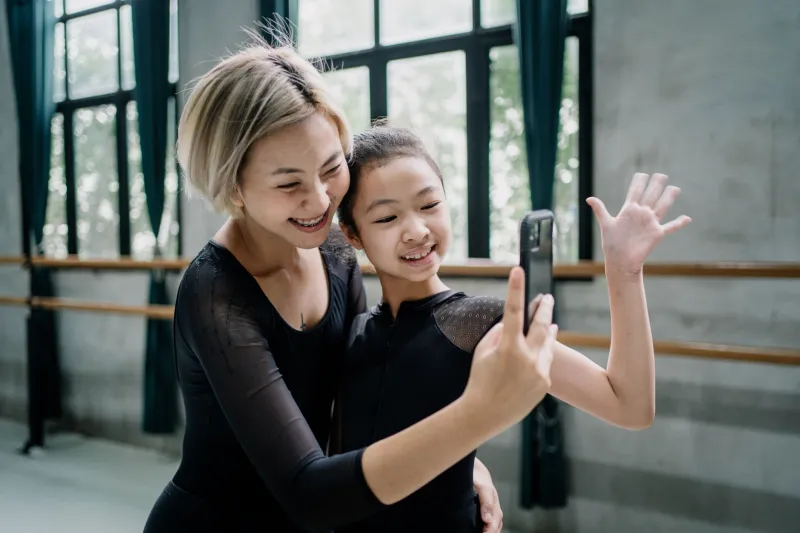
Somewhere between the barre and the For You Page, something complicated is happening to the identity of the classically trained dancer.
On one side: years of rigorous technical formation, an aesthetic vocabulary built from thousands of hours of repetition, a tradition that prizes precision, lineage, and a very specific idea of what excellence looks like. On the other: a platform that rewards spontaneity, relatability, and the kind of unpolished, personality-forward content that formal training specifically teaches you to suppress.
Navigating between these two worlds isn't just a scheduling challenge. For a growing number of formally trained dancers, it's an identity question — one that cuts right to the heart of what they believe about their art, their bodies, and their worth.
The Pressure to Be Two People
Maya Chen has been dancing ballet since she was four years old. She trained at a prestigious pre-professional academy in the Pacific Northwest, joined a regional company at nineteen, and has spent the better part of a decade performing repertoire that most audiences would recognize — the classics, the modern commissions, the occasional touring production. She is, by any traditional measure, a serious artist.
She is also, increasingly, a content creator. Her TikTok account, where she posts a mix of behind-the-scenes rehearsal footage, comedic takes on ballet culture, and occasional tutorials, has grown to nearly 80,000 followers. The platform has brought her brand deals, visibility, and a fanbase that her company's marketing department would never have reached.
It has also, she admits, brought a persistent low-grade anxiety about who she is when the camera is on. "In the studio, there's this standard — this very clear idea of what good looks like," she says. "Online, the things that perform best are the things that feel the least like that. The bloopers. The relatable moments. The times I look like a normal person and not a dancer."
The irony isn't lost on her. "I spent twenty years trying not to look like a normal person," she says, laughing. "And now that's the content."
What "Good Dancing" Means on a 15-Second Loop
The algorithmic logic of short-form video has introduced a new aesthetic standard into dance culture — one that operates almost entirely independently of technical merit. Virality favors impact over refinement. It rewards the move that reads in the first half-second, the personality that breaks the fourth wall, the dancer who makes you feel like you could do it too.
This is not, to be clear, a bad thing. Accessibility in dance is genuinely valuable. The explosion of diverse movement styles reaching mainstream audiences through social media has been broadly positive for the field. But it creates a specific kind of friction for artists whose entire training has been oriented around a different definition of quality.
Modern dancer and choreographer Dario Espinoza, who trained at a conservatory in the Midwest before building an independent practice in New York, has thought hard about this tension. "Classical training gives you a very particular relationship to your own movement — a kind of internal standard that's always running," he says. "When I post online, I'm constantly aware of the gap between what I know about what I'm doing and what the viewer is actually seeing. Those are two completely different experiences of the same thing."
He's not opposed to the platform — he uses it actively and values the audience it's built. But he's honest about the cost. "Every time I optimize something for the algorithm, I'm making a choice about what I'm centering. Sometimes that choice aligns with my artistic values. Sometimes it doesn't. Knowing the difference is the work."
The Authenticity Trap
One of the dominant values in social media content culture is authenticity — the idea that the most compelling content is the most real, the most unguarded, the most genuinely you. For classically trained dancers, this creates a particular kind of double bind.
Formal training is, in many ways, the opposite of unguarded. It's the systematic replacement of natural movement patterns with acquired ones. The turned-out hip, the elongated neck, the held-in core — these are not authentic expressions of how a body wants to move. They are disciplined impositions of a technical aesthetic. The "authentic" version of a ballet dancer, stripped of training, is just a person.
Ballerina and content creator Simone Park, who dances with a mid-sized company in the Southeast and maintains an active presence on both Instagram and YouTube, has made a conscious decision about how to handle this. "I don't try to be 'authentic' in the way that word gets used online," she says. "I try to be honest. Those are different things. I can be honest about what this life is like, what this body goes through, what I love and what's hard — without pretending I'm not a trained dancer. The training is part of who I am."
Her approach — treating her technical background as a feature rather than a liability in her content — has resonated. Her most successful videos are often the ones that take viewers inside the technical complexity of what she does, translating the invisible labor of classical dance for an audience that's never been inside a professional rehearsal.
"People don't know what they're watching when they watch ballet," she says. "If I can show them, that's not selling out. That's education. That's advocacy for the form."
Code-Switching and the Cost of Constant Translation
The term "code-switching" comes from linguistics, describing the practice of shifting between languages or communication styles depending on context. In the dance world, it's becoming shorthand for the constant register-shifting that formally trained dancers do as they move between elite performance contexts and digital platforms.
It's exhausting in ways that are hard to quantify. Every context shift requires a recalibration — of posture, of persona, of what version of yourself you're leading with. Dancers who do this well make it look effortless. Most will tell you it's anything but.
"I sometimes feel like I have a studio self and a phone self, and they're not always in conversation with each other," says Maya Chen. "My studio self would cringe at some of the content my phone self makes. My phone self thinks my studio self needs to loosen up. Figuring out who I actually am in the middle of that is ongoing."
A New Kind of Artistic Literacy
What's emerging, slowly, is a generation of dancers who are developing a genuine fluency in both registers — who can move between a demanding rehearsal process and a camera-ready content moment without losing their sense of self in either space.
This isn't code-switching as survival strategy. It's something more like artistic bilingualism — a real capability, not a compromise. The dancers building this fluency tend to be the ones who've gotten clear on their own values: what they're making content for, who they're making it for, and what they're not willing to trade away in the process.
Dario Espinoza frames it as a creative challenge rather than a crisis. "Every new medium changes what dance can be," he says. "Film changed it. Television changed it. Social media is changing it again. The question isn't whether to engage — it's how to engage without losing what makes the work worth watching in the first place."
That question, it turns out, is exactly the kind of thing serious artists have always had to answer. The platform is new. The problem of integrity isn't.