Bodies in Resistance: The Choreographers Turning Movement Into a Political Act
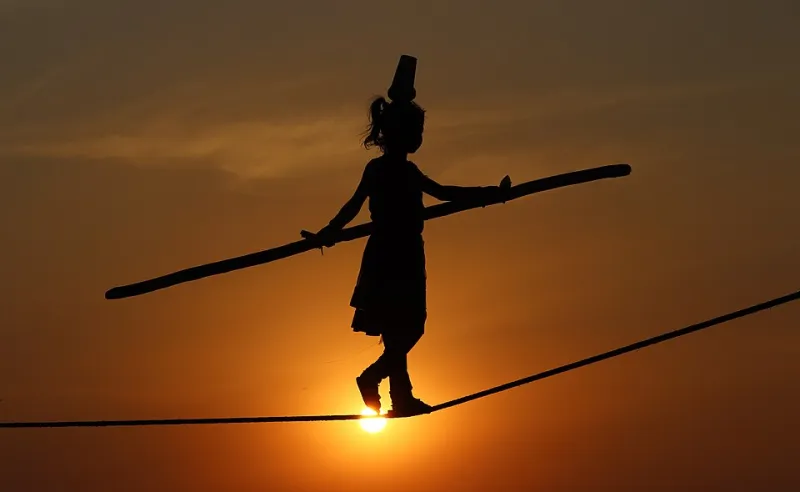
Photo: Derivative work: IamMM, Original: Manir Dhabak, CC BY-SA 4.0, via Wikimedia Commons
There's a moment in Amara Nduka's piece Thresholds — performed last fall at a site-specific installation in South Los Angeles — where twelve dancers collapse simultaneously to the ground. They stay there. The audience waits. Nobody moves. The silence lasts longer than is comfortable, longer than feels like choreography, until it starts to feel like something else entirely: grief, maybe. Or witness.
"I wanted people to sit with the weight of that," Nduka says. "Not to explain it, not to give them an out. Just — stay here for a second. Feel what this actually is."
That moment wasn't improvised. It was meticulously constructed. And it was political in the most precise sense of the word: it was designed to shift something in the people watching it.
Across the country right now, choreographers and performers are doing this kind of work — using the body as both instrument and argument, creating pieces that don't just comment on the cultural moment but actively intervene in it.
Why Dance, Why Now
Political art isn't new. Dance has been tangled up with resistance and reclamation for as long as there have been people with power and people without it. From the preservation of African movement traditions through slavery's attempted erasure, to the protest choreography of the civil rights era, to ACT UP's die-ins in the 1980s, the body has always been a site of political meaning.
But something feels particularly urgent right now. Artists and scholars who study this intersection point to a cultural moment characterized by deep polarization, a renewed reckoning with racial justice, climate anxiety that's especially acute among younger generations, and a widespread sense that conventional political speech — speeches, op-eds, social media posts — is hitting a wall.
"Language has become so weaponized and so tribalized that people have stopped actually hearing each other," says cultural critic and dance writer Priya Mehta. "Movement bypasses some of those defenses. It communicates through the nervous system before the analytical brain can put up its walls."
That's not mysticism — it's increasingly backed by neuroscience. Research on embodied cognition suggests that watching movement activates mirror neurons in ways that verbal communication doesn't, creating a kind of involuntary empathy response. Political choreography, at its best, exploits that pathway intentionally.
Reclaiming the Body, Reclaiming the Story
For many artists of color, the political dimension of their work isn't a choice they made — it was built into the conditions of their existence.
Josephine Reyes, a Filipina-American choreographer based in Seattle, describes her 2024 work Archipelago as a reclamation project. The piece draws on traditional Filipino folk dance forms that were suppressed or commodified during the US colonial period in the Philippines, reconstructing them alongside contemporary movement vocabularies.
"When you erase a people's movement traditions, you're erasing their way of understanding themselves in the world," she says. "Bringing those forms back — centering them, taking them seriously as art — that's not nostalgic. That's a political act."
Similar reclamation work is happening across communities. Black concert dance companies are interrogating the whiteness baked into classical ballet's aesthetics and institutions. Indigenous choreographers are asserting sovereignty over ceremonial movement traditions that have been appropriated, misrepresented, or banned. Queer artists are using the dancing body to challenge the violent policing of gender expression.
None of this is protest in the narrow sense of marching with signs. It's something deeper — a rewriting of whose bodies are considered worthy of artistry, attention, and care.
Climate, Democracy, and the Anxiety Underneath Everything
Not all political choreography is rooted in identity politics. A growing number of artists are grappling with what might be called the ambient dread of the current moment — the climate crisis, the fragility of democratic institutions, the particular psychic toll of living through a period that feels genuinely uncertain.
River Castillo, a non-binary choreographer and former Alvin Ailey ensemble member, premiered Forecast in Chicago this past winter — a 45-minute work for six dancers that used weather patterns as both structural metaphor and literal movement vocabulary. Sections were titled with climate data: rising temperatures, ice shelf loss, parts per million of atmospheric CO2.
"I didn't want to lecture anyone," Castillo explains. "I wanted to make people feel the scale of it in their bodies, because I think that's the only way it actually lands. Statistics don't move people. Movement moves people."
Audience response to Forecast was notably physical — people reported shallow breathing, tears, a kind of somatic distress that persisted after the performance ended. Several audience members described it as the first time they'd felt the climate crisis as a real, present thing rather than an abstract future problem.
That's a kind of political efficacy that a policy paper can't replicate.
The Tension Between Art and Activism
This work isn't without its complications. There's an ongoing, sometimes heated debate within the dance community about the relationship between artistic integrity and activist intention — whether work that's too explicitly didactic loses something essential, or whether the urgency of the moment makes aesthetic purity a luxury.
"I've had this conversation so many times," says Nduka. "And honestly, I think it's a false binary. The most powerful political art is also just — good art. The two things aren't in conflict. If anything, the political stakes sharpen the craft."
Others are less certain. Some choreographers worry about work that's so message-driven it becomes illustration rather than experience, losing the ambiguity and openness that makes art transformative rather than merely instructive.
But perhaps the more interesting question isn't whether political dance can be good art. It's whether, in this particular moment, any art that ignores the political conditions surrounding it can fully be considered art at all.
The Stage as Commons
What strikes you, talking to these artists, is how many of them describe their work not just as expression but as invitation — a way of creating a shared space where something collective can happen.
In a culture that feels increasingly fragmented, the live performance event — bodies in a room together, breathing the same air, moved by the same thing at the same time — has taken on a particular resonance. The stage, for these choreographers, isn't a platform for broadcasting a message. It's a commons. A place where the political becomes personal because it first becomes physical.
"I want people to leave changed," says Reyes. "Not convinced of something specific, necessarily. Just — changed. Open. A little more porous than when they walked in."
That's always been what great dance does. Right now, it also happens to be exactly what we need.