Speak Now or Forever Hold Your Peace: The Hidden Power Games Playing Out in Rehearsal Rooms
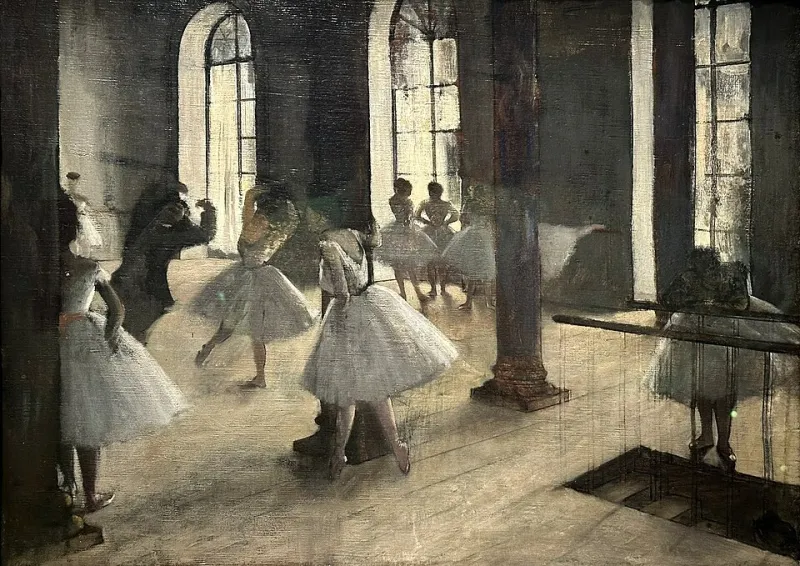
Photo: Edgar Degas, Public domain, via Wikimedia Commons
There's a moment most dancers know intimately. You're mid-rehearsal, something feels wrong — maybe it's a lift that's torquing your shoulder at a bad angle, or a directorial note that contradicts everything your body instinctively understands about the phrase — and you open your mouth to say something. Then you close it again. You file it away somewhere behind your sternum and keep going.
That moment of swallowed speech? It has a cost. And the dance world is only beginning to reckon with how high that cost actually runs.
The Room Where It Happens (Or Doesn't)
The rehearsal room is supposed to be a creative laboratory. In theory, it's where ideas get tested, discarded, rebuilt, and refined. But in practice, a lot of American dance companies — from major ballet institutions to mid-size contemporary companies to university programs — operate on a deeply embedded hierarchy that determines whose voice carries weight and whose gets quietly absorbed into the walls.
At the top: the choreographer, often followed closely by a rehearsal director or ballet mistress. Below them, principal dancers, soloists, corps members. And somewhere near the bottom of that invisible org chart sits the newest, youngest, or least established dancer in the room — the person with, statistically speaking, the most to lose by speaking out of turn.
"I spent two years in a company where I genuinely believed that asking a clarifying question was a career risk," says one contemporary dancer based in Chicago who asked to remain anonymous. "Not because anyone said that explicitly. It was just the vibe. You read the room and you understood: your job is to execute, not to interrogate."
That kind of implicit messaging doesn't just shape artistic outcomes. It shapes bodies. When dancers don't feel safe flagging pain, they push through injuries that become chronic. When they can't question choreographic choices that don't serve their physicality, they contort themselves — sometimes literally — to fit a vision that was never built with them in mind.
Injury, Silence, and the Culture of Pushing Through
The connection between hierarchical rehearsal culture and physical harm is one that sports medicine professionals and dance health advocates have been raising for years, but it's slow to translate into systemic change on the studio floor.
Dr. Linda Hamilton, a psychologist who has worked extensively with performing artists, has written about how the perfectionism and obedience trained into dancers from a young age makes them uniquely susceptible to ignoring their bodies' warning signals. The message absorbed early — pain is weakness, stopping is failure — doesn't evaporate when a dancer turns professional. It just gets reinforced by a new set of authority figures.
What makes this particularly thorny is that the line between productive discomfort and genuine injury is one that only the dancer inside that body can truly assess. But in a room where questioning the process is culturally coded as difficult or unprofessional, that assessment rarely gets voiced until the damage is already done.
Some companies are trying to interrupt this pattern structurally. A handful of mid-size contemporary companies have introduced designated check-ins at the start of rehearsal — not just a perfunctory "anyone hurt?" but a genuine, low-stakes opportunity for dancers to flag physical concerns without it feeling like a disruption to the creative flow. Others have brought in independent wellness liaisons, separate from the artistic staff, so that dancers have a channel for raising concerns that doesn't run directly through the person who controls their casting.
When Choreographers Actually Listen
It's worth saying clearly: not every rehearsal room is a pressure cooker of silence. There are choreographers actively working to build something different — creative environments where the dancer's embodied knowledge is treated as a resource rather than a variable to be managed.
Choreographer Francesca Harper, who has worked across ballet, Broadway, and her own independent projects, has spoken publicly about the importance of what she calls "collaborative authorship" — the idea that the people executing the work have something irreplaceable to contribute to its making. That's not just a feel-good philosophy. It's a practical creative strategy. Dancers who feel heard tend to invest more deeply in the work. They bring their full intelligence to it, not just their technique.
Similarly, companies like Batsheva's American touring productions and several of the newer Black-led contemporary companies emerging out of cities like Atlanta, D.C., and Los Angeles are modeling rehearsal structures that actively solicit feedback, build in time for questions, and treat directorial authority as something that coexists with — rather than cancels out — the dancer's own artistic perspective.
"The best rehearsals I've ever been in felt like conversations," says Marcus Webb, a freelance dancer and choreographer based in Brooklyn. "The director had a vision, absolutely. But there was room for the vision to get smarter because of who was in the room."
The Union Factor
It's impossible to talk about power in the rehearsal room without talking about labor protections — or the lack thereof. Dancers covered under AGMA (American Guild of Musical Artists) or Actors' Equity have contractual frameworks that, at least on paper, give them recourse when rehearsal conditions become unsafe or when their concerns are ignored. But a significant portion of the American dance workforce operates outside of union coverage, particularly in contemporary, independent, and community-based contexts.
For non-union dancers, the calculus of speaking up is stark. There's no grievance process, no shop steward, no contractual language to point to. There's just the relationship — and the fear of what happens to that relationship if you push.
Advocacy organizations like the Dance/NYC Justice, Equity, Diversity, and Inclusion (JEDI) initiative have been pushing for more transparent labor standards across the sector, including clearer norms around rehearsal conditions and artist rights. It's slow work, but it's building.
What a Better Room Actually Looks Like
Here's the thing about power dynamics: they're not always dramatic. They don't always look like a choreographer screaming at a dancer or a company director playing favorites. Often they're much quieter than that — a culture of eye contact that signals agreement even when no agreement exists, a rehearsal pace that leaves no room for processing, a tone that makes questions feel like interruptions.
Building rehearsal rooms where all voices are genuinely heard — not just tolerated — requires intentionality at every level. It means choreographers actively inviting input and meaning it. It means rehearsal directors who model curiosity rather than compliance. It means companies investing in the structures (wellness check-ins, anonymous feedback channels, clear injury reporting protocols) that make it easier to speak up.
And it means dancers themselves, wherever possible, finding the courage to say the thing they've been holding behind their sternum. Because the work gets better when they do. And more importantly — so do they.